


 Deutsch
 English
 Español
 Français
 Nederlands
 Português


 Share
Share




What Are the Trump Tariffs and Why Are 24 States Suing?
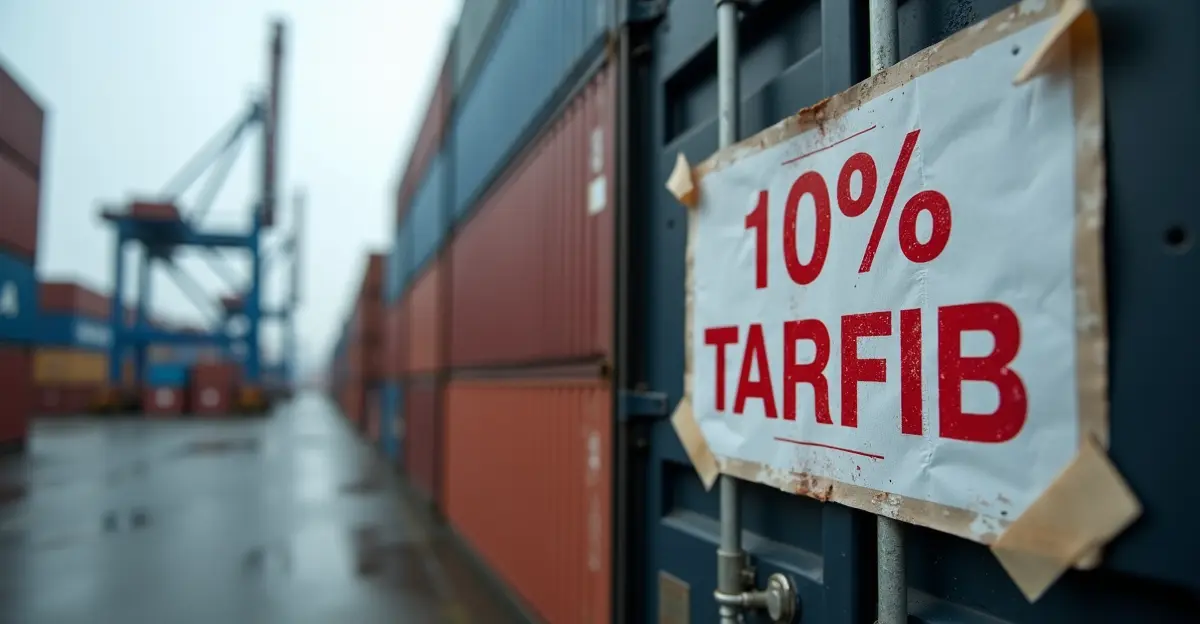
A coalition of 24 U.S. states has filed a major lawsuit challenging President Donald Trump's newly imposed 10% global import tariffs, marking the latest legal battle over presidential trade authority. The lawsuit, filed on March 5, 2026, comes just weeks after the Supreme Court struck down Trump's previous tariff powers, creating a constitutional showdown over whether the president can circumvent Congress to impose sweeping trade measures. The states argue that Trump's use of Section 122 of the Trade Act of 1974 represents an illegal 'end run' around the Supreme Court's February 20 ruling that invalidated his authority under the International Emergency Economic Powers Act (IEEPA).
Background: From IEEPA to Section 122
The legal battle over Trump's tariffs represents a fundamental constitutional question about presidential power. On February 20, 2026, the Supreme Court ruled 6-3 in Learning Resources Inc. v. Trump that the International Emergency Economic Powers Act (IEEPA) does not authorize the president to impose sweeping, open-ended tariffs. The Court emphasized that revenue-raising tariffs constitute an exercise of the taxing power reserved for Congress under the Constitution's Taxing Clause, requiring explicit congressional delegation. Within hours of this ruling, the White House announced new 10% tariffs using Section 122 of the Trade Act of 1974, a rarely used statute designed for balance-of-payments emergencies.
Kenneth Manusama, an American law expert and specialist in U.S. constitutional law, explains the core issue: 'The problem is that these tariffs may only be imposed when the balance of payments faces serious problems. That happened in the past with fixed exchange rates, but that doesn't happen anymore. So this law is actually intended for non-existent situations. The question is how relevant the court considers the law in the current context.'
Legal Arguments: Why States Say the Tariffs Are Illegal
The Section 122 Controversy
Section 122 of the 1974 Trade Act was created as a narrow emergency authority for presidents to impose temporary import surcharges during fundamental international payments crises. Congress designed it in response to President Nixon's 1971 imposition of a 10% import surcharge without explicit authorization. The statute allows tariffs up to 15% for 150 days maximum, requiring 'fundamental international payments problems' as justification. However, economists argue this authority became outdated when the U.S. moved to floating exchange rates in the 1970s, as balance-of-payments crises in the classical sense cannot occur under the current monetary system where trade deficits are balanced by foreign investment inflows.
The 24 states, led by New York, California, and Oregon, argue that Trump is misusing this emergency authority to address routine trade deficits rather than genuine balance-of-payments emergencies. The White House cites alarming economic data including a $1.2 trillion goods trade deficit in 2024, a current account deficit of -4.0% of GDP, and a negative net international investment position of $26 trillion (89% of GDP) as justification for the emergency action.
Presidential Power vs. Congressional Authority
The lawsuit highlights a recurring theme in Trump's trade policy: circumventing Congress. As Manusama notes: 'The previous tariffs were based on the so-called International Emergency Economic Powers Act, an emergency law. That law gave the president very broad powers. When the tariffs were declared unlawful by the Supreme Court, the administration quickly sought a legal basis to still be able to impose import tariffs. But with these kinds of lawsuits, there are fewer and fewer possibilities for Trump.'
Both the old and new tariffs share the characteristic of bypassing Congress, but with all the lawsuits, Trump seems condemned to follow 'the royal route' and ask parliament to impose import tariffs. However, even there he can expect considerable resistance, including from Republicans who, from an old Republican free trade standpoint, see tariffs as bad economic policy. In that sense, it is becoming increasingly difficult for Trump.
Economic Impact and Consumer Consequences
The Yale Budget Lab analysis reveals significant economic implications of the Supreme Court's February 2026 decision. Without IEEPA tariffs, the average effective tariff rate drops to 9.1% (vs. 16.9% if upheld), still the highest since 1946 excluding 2025. The ruling reduces consumer price increases from 1.2% to 0.6%, saving households approximately $800 on average. Unemployment is projected to rise by 0.3 percentage points by end of 2026, with 550,000 fewer jobs. Long-term GDP will be 0.1% smaller ($30 billion annually), significantly less than the 0.3% contraction if IEEPA tariffs remained.
The decision triggers $142 billion in tariff refunds to importers, creating a temporary fiscal stimulus that offsets negative growth impacts in 2026. Manufacturing expands by 1.2% but construction contracts 2.4% and agriculture declines over 1%. These economic realities underscore why states are fighting the tariffs, which they argue disproportionately harm their economies and consumers.
What Happens Next: Legal and Political Implications
The lawsuit represents more than just a legal challenge—it's a political statement about the limits of executive power. The 24 states are asking the court to block the new tariffs and order refunds of any payments already made. White House spokesperson Kush Desai stated the administration will vigorously defend the president's action, claiming Trump is using his authority to address 'large and serious' balance-of-payments deficits.
This legal battle comes amid broader discussions about presidential emergency powers and their application to economic policy. The outcome could set important precedents for future administrations seeking to use executive trade authority without congressional approval. As the case progresses through the courts, businesses and trading partners worldwide will be watching closely to understand the future of U.S. trade policy.
Frequently Asked Questions
What is Section 122 of the Trade Act of 1974?
Section 122 is a rarely used statute that allows presidents to impose temporary import surcharges of up to 15% for 150 days during fundamental international payments crises. It was designed as emergency authority but critics argue it's outdated in today's floating exchange rate system.
Why did 24 states file this lawsuit?
The states argue that President Trump is misusing emergency authority to impose tariffs that should require congressional approval. They claim the tariffs harm their economies, increase consumer costs, and exceed presidential authority under the Constitution.
What was the Supreme Court's February 2026 ruling?
The Supreme Court ruled 6-3 that the International Emergency Economic Powers Act (IEEPA) does not authorize the president to impose sweeping, open-ended tariffs, striking down the legal foundation for Trump's previous tariff regime.
How do these tariffs affect consumers?
The 10% tariffs increase prices on imported goods, with economists estimating average household costs of $800 annually. The tariffs particularly affect electronics, clothing, and consumer goods imported from abroad.
What happens if the states win the lawsuit?
If successful, the tariffs would be blocked and any payments already made would need to be refunded. This would force the administration to seek congressional approval for any future tariff measures.




Follow Discussion